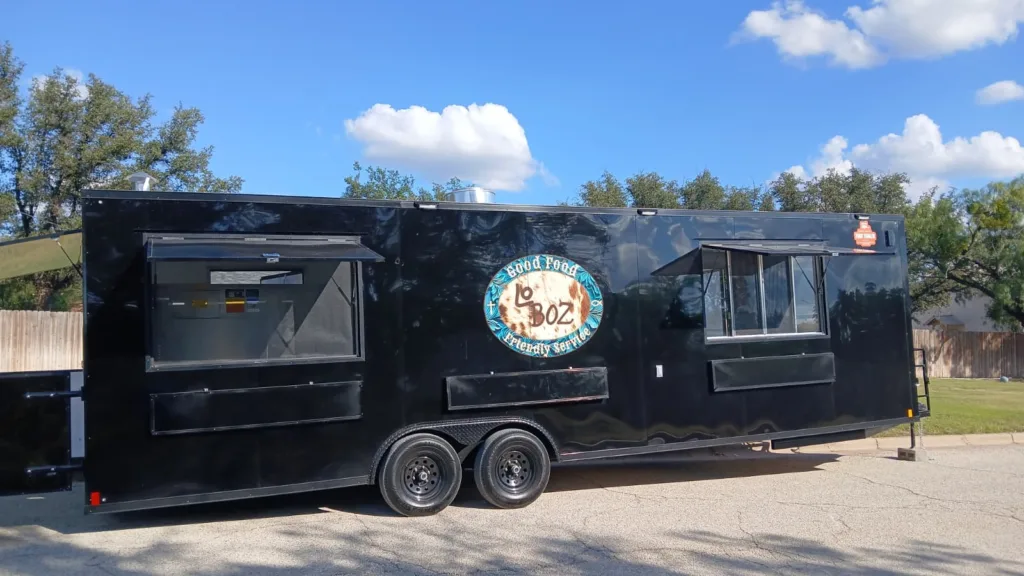
Having custom food trailers is extremely beneficial when it comes to guaranteeing proper regulatory compliance. This is because you can design the unit to meet current law and avoid fines, penalties, and potential business closures. For this, it is advisable to work with an experienced manufacturer who knows local regulations.
To ensure that your custom trailer complies with traffic law, you must verify that it has a homologated chassis capable of supporting the gross vehicle weight. You also need a braking system proportional to the load and a regulatory lighting scheme synchronized with the tow vehicle. It is essential to register the unit with the corresponding authorities using the purchase invoice, the technical data sheet of the components, and the vehicle identification number stamped on the frame.
Custom food trailers: the chassis and load capacity
The base structure of custom food trailers is the first thing road authorities inspect during any routine check. It is not just about the visible strength of the metal, but also about strict compliance with the weight limits allowed for trailers without an engine on the national road network. You need:
The Vehicle Identification Number (VIN)
Every legal unit must have a unique seventeen-digit serial number stamped directly into the chassis. This code is the birth certificate of your trailer and a mandatory requirement to process plates, registration cards, and insurance.
Weight distribution and axle design
A poorly balanced trailer is a critical hazard on the road. During custom fabrication, the position of the axles, whether single or tandem, must be calculated carefully based on the weight of heavy equipment such as fryers, refrigerators, and water tanks.
Certified tires and suspension
The tires must have an adequate load index to support the maximum estimated weight with the business fully stocked with supplies, work tools, and clean water. This avoids potential risks and allows you to pass inspections so the trailer can travel legitimately and safely.
Safety systems: brakes, lights, and regulatory hitch
To travel safely between cities, custom Texas food trailers must communicate perfectly with the vehicle towing them and respond autonomously to any emergency maneuver.
Independent braking mechanism
Traffic law requires that trailers exceeding a certain weight limit, generally above 750 kilograms, have their own brakes, either inertia or electric. This prevents the weight of the trailer from pushing and destabilizing the tow vehicle during a sudden stop.
Regulatory and synchronized lighting
Your food trailer must exactly mirror the light signals of your truck. This includes upper position lights, rear turn signals, intense brake lights, emergency flashers, and the mandatory white light that illuminates the rear plate.
Safety chains and couplings
The hitch system on the tow ball must include a safety lock with a pin and two crossed structural steel chains firmly attached to the tow vehicle. They act as a lifeline in case the main hitch fails.
Essential documentation to avoid penalties and fines
Meeting the mechanical aspects is only half the job. In fact, administrative management is crucial to drive with full peace of mind on federal highways and city streets. Universal Food Trailer explains this to you in detail, below:
- Manufacturer technical data sheet: this detailed document specifies the exact dimensions of width, length, and height, as well as the net weight of the empty unit. It works as official proof that the design complies with current road engineering regulations.
- Specific insurance policy: it is essential that your auto policy includes extended civil liability coverage for trailers. This protects you from any accident or damage to third parties on public roads.
- Official license plate: custom food trailers for sale must carry their own government plate in a visible place, completely free of obstructions, and properly illuminated during nighttime trips.
Universal Food Trailer: custom units that comply with current laws
Our custom food trailers must correctly meet the various requirements of the traffic authorities to circulate legitimately and safely. At Universal Food Trailer we are recognized manufacturers with more than 7 years of experience in the market. Our experts know current law perfectly to offer you units that pass inspections without difficulty.
Want to request a quote? Send us a message at our email address info@universalfoodtrailer.com or contact us by phone at (830) 955 8655. We will gladly provide the information you need as soon as possible.
Frequently Asked Questions
What type of driver’s license is needed to tow a large food trailer?
Generally, if the combined weight of the tow vehicle and the trailer exceed 3,500 kilograms, traffic law requires a commercial or special class B or C driver’s license.
Is it mandatory to pass a state mechanical inspection to register the trailer?
Yes. Traffic authorities usually require a physical and mechanical inspection of the unit to validate that the lights, brakes, and chassis number match the factory documentation.
Can you drive at night with a large custom food trailer?
Yes, if the trailer has regulatory reflective tape on the sides and rear and keeps the entire system of rear and upper lights on continuously.